
Tomato ingredients, engineered for your formula.
Atlas Global Trading Co. connects food manufacturers, distributors, importers and private-label programs with premium tomato paste and tomato ingredients from qualified farms, processors and supply partners around the world. We organize sourcing around the technical performance, packaging, documentation and commercial requirements that matter in the customer's finished product.
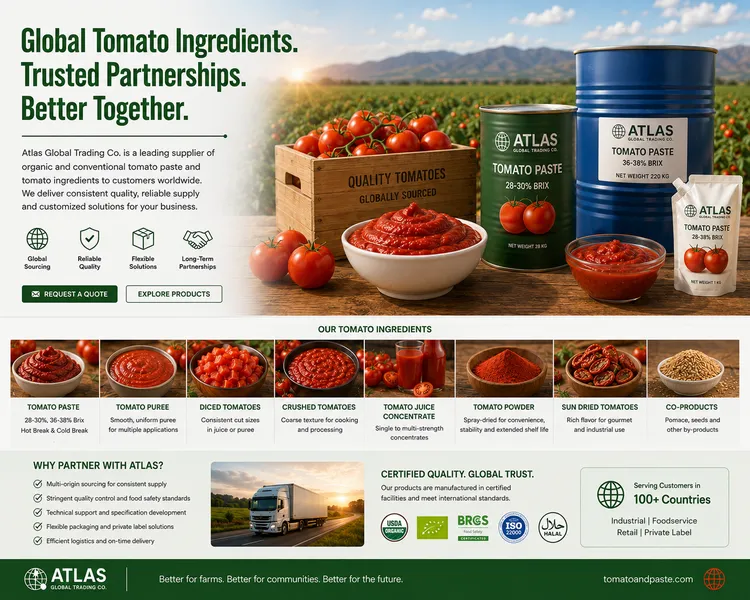
One sourcing desk. A complete tomato toolkit.
Tomato paste is only the beginning. We organize sourcing around the performance manufacturers actually buy: solids, viscosity, texture, piece identity, color, flavor, process stability, packing efficiency and documentation. This makes it easier to compare products according to their role in the finished formulation rather than product name alone.
Tomato Paste
Hot break, cold break, 28–30°, 30–32° and 36–38° Brix programs, conventional and organic, with options selected according to solids, viscosity, color and application requirements.
View paste →Wet Ingredients
Puree, pulp, concentrated crushed, diced, whole peeled, chopped and roasted formats for sauces, prepared foods and applications requiring different levels of tomato texture and piece identity.
View formats →Juice & Concentrates
Tomato juice, juice concentrate and clarified tomato concentrate for culinary and beverage systems where liquid handling, flavor delivery and controlled solids addition are important.
View liquids →Dry & Dried
Powder, flakes, granules, sun-dried, semi-dried and selected upcycled tomato ingredients for dry mixes, seasonings, inclusions, prepared foods and specialty formulations.
View dry ingredients →Better sourcing begins with application logic.
Our application library is designed around real manufacturing decisions: ketchup viscosity, pizza-sauce texture, retort stability, solids calculations, sample qualification, COA review, packaging, organic documentation and landed-cost comparisons. The objective is to connect ingredient characteristics with the way the product must perform in actual production.
Body & cling
Hot-break and texture-forward tomato ingredients for ketchup, pizza sauce and other formulations that need structure, body and water binding. Exact performance depends on concentration, consistency, finish and the customer's process.
Color & fresh profile
Cold-break and selected liquid ingredients where bright tomato color, fresher flavor character and lower viscosity may be desirable in the finished formulation.
Pieces & inclusions
Diced, crushed, roasted, sun-dried and dehydrated formats for visible tomato identity, controlled particle size and texture in sauces, meals, bakery applications and foodservice products.
Organic sourcing should be traceable, documented and practical.
We treat “organic” as a supply-chain requirement, not a marketing adjective. Product scope, processor approval, certification status, lot identity and destination-market needs must align before a claim is made. Where relevant, documentation is reviewed in connection with the actual product and supply program rather than treated as a generic supplier-level statement.
Our sourcing approach →Buyer-ready documentation framework
- Product specification / technical data sheet
- Certificate of analysis and lot identification
- Organic documentation where applicable
- Food-safety and quality-system records where available
- Packaging and pallet configuration
- Origin, crop and traceability information
- Destination-specific documents by contract
- Customer-specific approval requirements where agreed
The more specific the requirement, the better the match.
Industrial tomato sourcing becomes more efficient when technical, packaging and logistical expectations are defined early. Even a short sourcing brief can help narrow the appropriate product format, processor and origin.
Technical target
Share the product type, target Brix or solids, hot-break or cold-break preference where relevant, consistency or viscosity, color, pH, finish, particle size or other important performance requirements.
Commercial format
Define the preferred pack type, approximate annual or project volume, delivery destination and expected shipment pattern so suitable industrial, foodservice or retail programs can be evaluated.
Approval requirements
Include organic status, certification needs, technical documentation, samples, customer approval processes and any origin or destination-specific requirements that must be satisfied before shipment.
Tell us what your factory needs to make.
Share product type, organic or conventional status, target solids/Brix, process preference, viscosity or texture requirements, packaging, annual volume and destination. If you already have a specification or benchmark product, include the relevant parameters and we’ll help structure the right sourcing brief.